The S$2.93 Million Leonie Gardens Profit Took 28 Years. That's the Story.
Everyone is quoting the profit. Almost nobody is doing the division.
The short read
A 2,540 sq ft four-bedder at Leonie Gardens sold on June 18 for S$4.2 million, earning its owner a S$2.93 million profit on a 1998 purchase at S$1.27 million. That is a 230.7% gain — but spread over nearly 28 years, it works out to 4.4% a year.
The lesson is not that District 9 prints money. It is that prime-district condos have rewarded patience, not timing — and the same week's data shows the opposite outcome at Sentosa, where every Marina Collection resale since 2025 has closed at a loss.
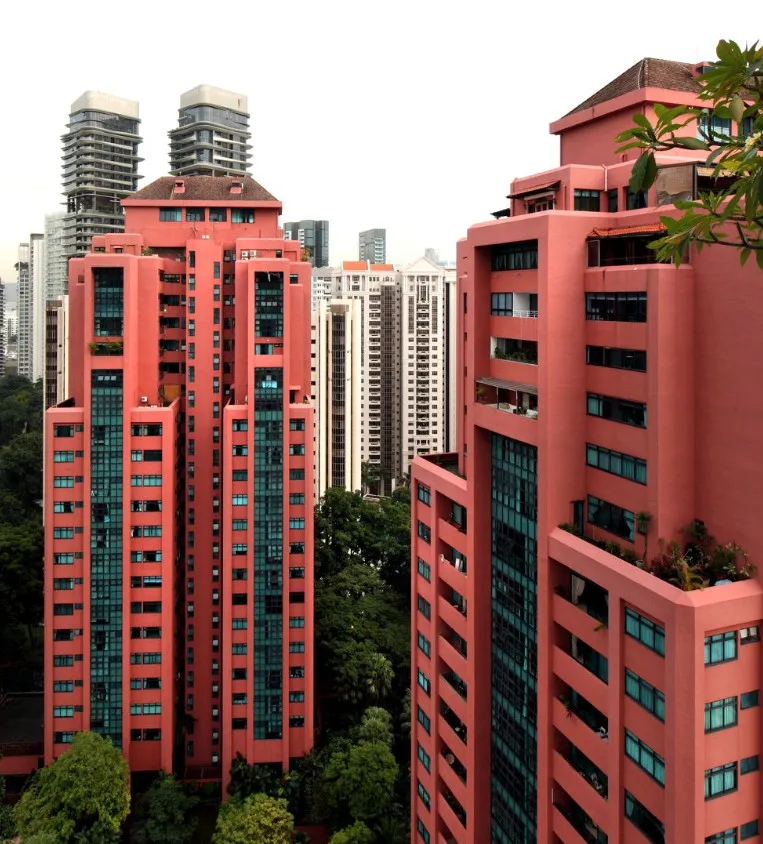
There is a number moving through property chats this week: S$2.93 million. That is the profit on a 2,540 sq ft four-bedder at Leonie Gardens in District 9, sold on June 18 for S$4.2 million, or $1,653 psf. As EdgeProp reported, it was the most profitable condo resale of the week of June 16 to 23, and the second-highest profit ever recorded at the project.
The seller bought the unit in October 1998 for S$1.27 million — $500 psf. The gain works out to 230.7%.
Here is the part of the article that deserves more attention than the headline: the holding period. It is right there in the fine print, and almost nobody in those property chats is quoting it. Nearly 28 years. Do the division and the S$2.93 million becomes 4.4% a year.
That single act of division changes what this story means for your family. So let’s actually do it.
What does 4.4% a year really tell you?
A 230.7% gain sounds like a coup. A 4.4% annualised return sounds like what it actually was: a solid, unspectacular outcome earned by owning a home through five market cycles — the Asian financial crisis the seller bought into, the dot-com bust, SARS, the global financial crisis, the cooling-measure decade, a pandemic, and the current market.
Neither number is wrong. They are the same transaction viewed at two different altitudes. But only one of them is useful for decision-making, and it is not the one in the headline.
A profit without a holding period isn’t a return. It’s just a headline.
Across seventeen years of practice I have watched this pattern repeat: the absolute number travels, the annualised number gets left behind. Gains of this size in the Central Core Region have almost always been ten-plus-year holds. Prime District 9 has rewarded patience, not timing. The families who did well there bought a home to live in and let the decades do the quiet work.
What 4.4% does not tell you is that District 9 is a money machine. Over 28 years, a diversified portfolio of almost anything sensible would have compounded in the same neighbourhood of returns. What the family got that a portfolio does not provide: a 2,540 sq ft home on Leonie Hill, minutes from Orchard Road, that housed them the entire time. The return came with a roof. That is the honest framing.
The en bloc that never happened
There is a second story buried in this project’s history, and it is the more instructive one.
Leonie Gardens tried to sell en bloc in May 2018 at an S$800 million reserve. No bids. The owners relaunched in December 2018 at the same price. Again, no buyer. Twice, the collective exit failed.
At the time, that would have felt like a door closing. En bloc fever was the fastest imaginable payday, and Leonie Gardens missed it — twice.
Then look at what happened next. Since those failed attempts, the project has recorded 32 resale deals, owners exiting profitably unit by unit. In 2026 alone there have been three transactions: the June 18 sale, plus two units that went for S$3.1 million and S$4.2 million, netting their sellers S$670,000 and S$1.1 million respectively.
The owners who missed the en bloc didn’t miss the exit. They just took the slower door.
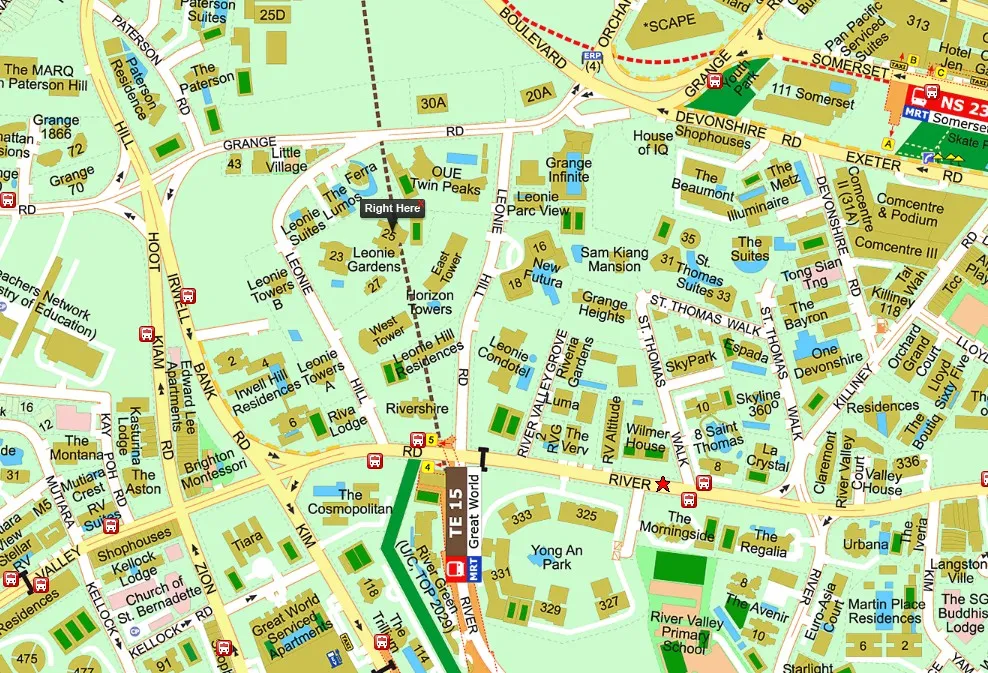
I find this genuinely useful for families holding older leasehold condos. An en bloc is one exit route, not the only one. A well-located project with 138 units, real living space (units here run 1,733 to 4,306 sq ft, three-bedders to penthouses) and a direct line to Great World MRT keeps generating its own buyers, one family at a time. The exit pool for a spacious prime-district home is deeper than any single collective-sale vote.
Same week, same market, opposite endings
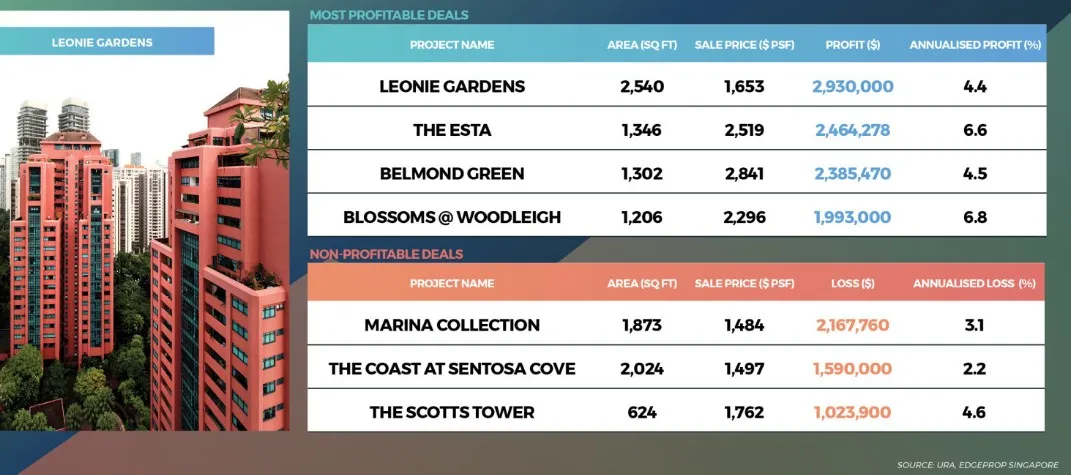
The most valuable thing in EdgeProp’s report is not the Leonie Gardens number. It is the table it sits in — because the same week produced radically different outcomes for owners who all held long.
| Project | Bought | Sold (Jun 2026) | Outcome | Annualised |
|---|---|---|---|---|
| Leonie Gardens (D9, 99-yr) | S$1.27m, Oct 1998 | S$4.2m | +S$2.93m (+230.7%) | +4.4% over ~28 yrs |
| The Esta (Marine Parade, freehold) | S$924,610, Jan 2006 | ~S$3.39m ($2,519 psf) | +S$2.46m (+266.5%) | +6.6% over ~20.5 yrs |
| Marina Collection (Sentosa, 99-yr) | S$4.95m, Jan 2008 | S$2.78m | −S$2.17m (−43.8%) | −3.1% over ~18.5 yrs |
Three long holds. Two families exit with life-changing gains. One exits S$2.17 million poorer after 18 and a half years of ownership.
And Marina Collection is not an unlucky one-off. Seven resales at the Sentosa waterfront project since 2025 — every single one in the red, with losses running from S$1.32 million to S$3.68 million. The project’s record loss stands at S$4.65 million, on a unit bought for S$9.3 million in March 2008 and sold at half that in 2023.
So no, time in the market does not guarantee a profit. Time rewards the right address at the right entry price. Marina Collection buyers in 2008 paid peak-exuberance prices for a waterfront lifestyle concept — private yacht berths, low-rise exclusivity — and eighteen years later the market still has not agreed with that pricing. Leonie Gardens buyers in 1998 paid crisis-era prices for an ordinary, well-located family condo, and time compounded quietly in their favour.
The Esta is the third data point worth noticing: freehold, family-sized, in the Marine Parade and Amber Gardens belt, and the best annualised performer of the three at 6.6%. Every one of its 2026 resales — seven in total — closed profitable. Liveable, family-shaped homes in established neighbourhoods keep finding their buyers.
What should a buyer read into the S$4.2 million side of this trade?
Every celebrated exit has a quieter counterparty: someone just paid S$4.2 million, at $1,653 psf, for the same unit. That family’s outcome is the one still being written, and their arithmetic is different from the seller’s in two important ways.
First, the entry. The seller compounded from $500 psf. The buyer starts from $1,653 psf. Nothing about the seller’s 230.7% transfers across the settlement table.
Second, the lease. Leonie Gardens is a 99-year leasehold completed in 1993. The seller bought a young lease; the buyer is taking over one with meaningfully less runway, and leasehold decay does not move in a straight line — it steepens. That does not make the purchase wrong. A 2,540 sq ft four-bedder a short walk from Great World MRT, in a district where new supply of family-sized units is scarce and priced far higher, can absolutely make sense as a home. But it makes sense as a home first, with the return as the by-product. That is exactly how the seller’s 28 years worked, too.
The test I would apply is the same one I use with families I advise: who buys this from you in fifteen years, and why? For this unit, there is a credible answer — a multi-generational family that needs genuine space in the city core, buying from a shrinking pool of large-format prime units. For Marina Collection in 2008, that answer was always hazier. The difference between those two answers is the difference between the top and bottom of this week’s table.
The read for families on a decade horizon
If you are 40 to 60, holding your second or third private property, and this headline made you wonder whether to chase District 9 or cash out of it, here is where I land.
This deal does not tell you today’s entry price will repeat the seller’s outcome. It does not tell you the CCR beats other regions on annualised returns — The Esta, in the city fringe, actually annualised higher. It does not tell a retiree the top is in, and it does not tell an upgrader the door is closing. It tells you that one address, over one 28-year stretch, aged well for one family — and that the same week, a different address punished patience with a S$2.17 million loss.
The variables that separated those outcomes were all visible on day one: the entry price relative to the cycle, the depth of the future buyer pool, and whether the property was a home families would always want or a concept the market had to keep believing in.
So the question worth sitting with is not “should I chase this” or “should I cash out now”. It is the older one: will we still be glad in seven years? That answer depends on your entry, your timeline, and the chapter your family is actually planning for. The Leonie Gardens seller answered it in 1998, then let 28 years do the work. The headline is theirs. The division is yours to do — before you sign, not after.
The numbers
| Project | Leonie Gardens, Leonie Hill, District 9 |
| Unit sold | 2,540 sq ft four-bedder, 8th floor |
| Sale (18 Jun 2026) | S$4.2 million ($1,653 psf) |
| Purchase (Oct 1998) | S$1.27 million ($500 psf) |
| Profit | S$2.93 million (230.7%) |
| Annualised return | 4.4% over ~28 years |
| Tenure | 99-year leasehold, completed 1993, 138 units |
| En bloc history | Failed twice in 2018 at S$800m reserve |
Questions families ask
Is a S$2.93 million condo profit a good return?
It depends entirely on the holding period. At Leonie Gardens the gain was 230.7% over nearly 28 years, which annualises to 4.4% a year. That is a solid, unspectacular return earned by owning a home through five market cycles — not a windfall from clever timing. The absolute number is impressive; the annualised number is honest.
Do 99-year leasehold condos still make money after 25 years?
This sale shows they can — the Leonie Gardens unit was bought five years after completion and sold profitably almost three decades later. But the address did the work: a prime District 9 location near Orchard Road and Great World MRT. Leasehold decay is real, and the next owner is buying a much shorter lease than the seller did. The question is always the specific project, not the tenure label.
Does this mean buying in District 9 today will produce the same result?
No. This deal tells you one family's 1998 entry price aged well. It says nothing about whether today's entry price will repeat that outcome — the seller bought at $500 psf; the buyer just paid $1,653 psf on a shorter lease. The same week's transactions included a S$2.17 million loss at Sentosa's Marina Collection. Outcomes are address-specific and entry-specific.
Should I hold my condo longer to guarantee a profit?
Time helps, but it is not a guarantee — Marina Collection owners held for 18-plus years and still lost 40% or more. What time does is smooth out cycles for well-located properties that families actually want to live in. The better question is whether your property passes the future-buyer test: who buys this from you in fifteen years, and why?
Reporting referenced: EdgeProp. Analysis and views are Adrian Lim's own.
Talking it through beats reading about it.
If this story touches a decision your family is weighing, send Adrian a message. A first conversation costs nothing and commits you to nothing.
WhatsApp Adrian · +65 8183 2333More from Insights
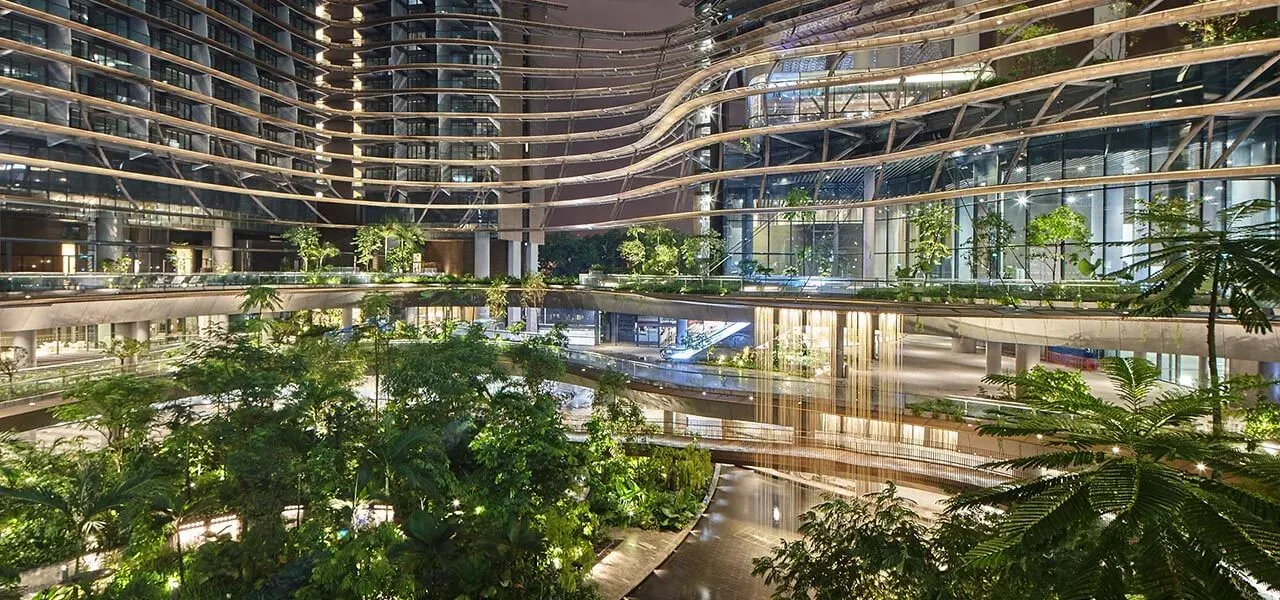
Marina One's $1,702 psf Record Low: What It Tells You About CCR Value
A record low at Marina Bay made headlines this week. The number is the easiest part of the story — the harder part is what it means, and for whom.
The S$880,000 landed home: what the price is actually telling you
The number is real. The number is also the easy part of the story.
The S$85 Million Cluny Hill Sale, and What It Doesn't Mean for You
An S$85 million bungalow sale finally surfaces a year after the deal was done. The quietness is the story.