Should Every Property Move Leave You Wealthier? The Honest Version
Treating your moves as a sequence rather than a series of one-offs is genuinely better thinking. It also breaks in two places, and both of them are expensive.
The short read
EdgeProp recently carried a veteran agent's framing that each property move should leave you in a stronger position than the last — a sequence of connected decisions rather than isolated transactions. That is a real improvement on both the quick-flip mindset and the drift of upgrading simply because it is what people do.
Two things the framework tends to under-weight. First, compounding assumes you are never a forced seller, and the thing that makes people forced sellers is the leverage they took on to make the last move work. Second, not every move is supposed to make you wealthier — some are supposed to make your life work, and measuring those on the same scale produces bad decisions about the people you live with.
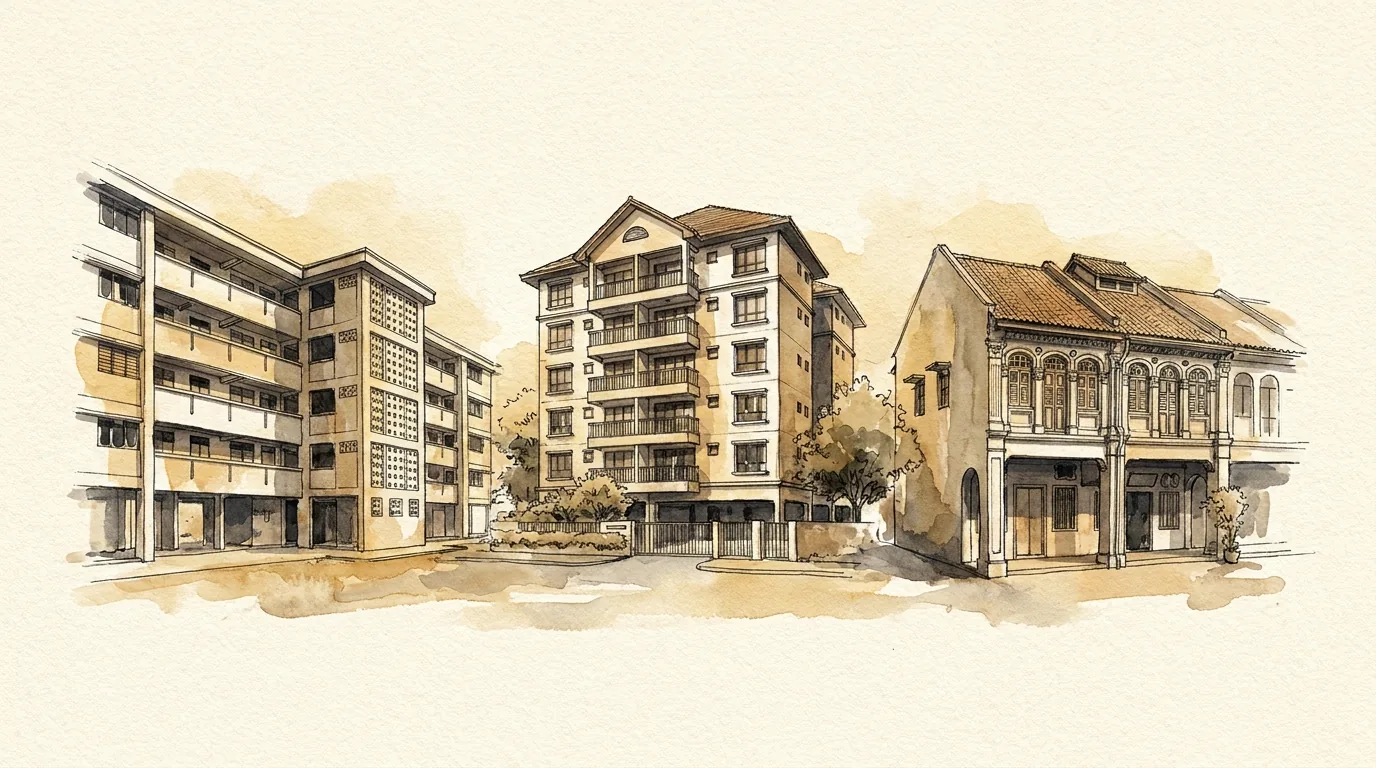
EdgeProp recently carried a piece built around a straightforward proposition from a nineteen-year veteran of this industry: every property move should leave you wealthier than the last. Not each transaction judged on its own profit, but a sequence — HDB to condominium to whatever comes after — where each step improves your position for the step after it.
I think the framing is a genuine improvement on the two attitudes it is arguing against, and I want to say why before I argue with it.
It beats flipping, which treats each transaction as a self-contained bet and ignores that you have to live somewhere between bets. And it beats drift, which is the far more common failure — upgrading because it is the expected thing to do at that stage of life, without anyone ever writing down what the upgrade is supposed to achieve.
So: sequence thinking, yes. Now the two places it breaks.
Compounding assumes you are never forced to sell
The mathematics of compounding require one condition that rarely gets stated: you have to survive every intervening period without being forced to act.
Property compounds through holding. Every model of a sequence of moves quietly assumes that at each point you sold because you chose to, at a price you were willing to accept. Take that assumption away and the arithmetic inverts — a forced sale in a soft quarter can undo the gains of two good decisions, and the loss is permanent in a way that a paper decline is not.
What produces forced sellers is almost never the property. It is the financing structure carried into it. A household that stretches to the edge of what TDSR permits, on the assumption that income rises and rates behave, has bought a good asset and an obligation to be lucky. When the job changes, or the rate resets, or a parent’s medical costs arrive, the asset is fine and the household is not.
So when I hear that each move should leave you wealthier, I would add: measured how? If wealth means the paper value of what you own, plenty of moves qualify. If it means your ability to withstand a bad year without selling anything, far fewer do — and that second measure is the one that determines whether you ever get to the next move at all.
The most valuable thing a family carries from one move to the next is not equity. It is the ability to wait.
Not every move is supposed to make you richer
The second gap matters more to me, because I see its consequences in living rooms rather than spreadsheets.
Some moves exist to make a life work. A family moves closer to ageing parents because forty minutes each way is no longer sustainable. A household stays in a flat past the optimal exit because a child is two years from a major exam and nobody wants to move schools. Someone right-sizes early, giving up a property that would probably have appreciated, because they would rather have the cash flow and no stairs.
On a strict compounding view, some of these are mistakes. In practice they are frequently the best decisions those families made, and the framework has nothing to say about them except that they cost something.
My version of the rule is narrower and, I think, more honest. Every move should leave you knowing what it cost. If you are moving for wealth, be specific about the mechanism and check it survives a bad year. If you are moving for life, be specific about the price and pay it deliberately. What ruins families is not choosing the second one. It is choosing the second one while telling themselves it is the first.
Where the money is actually lost
If you take one practical thing from this piece, make it this: the risk in a move sequence is concentrated in the seams, not the selections.
I have watched a lot of households transact since 2008, and the ones who came out badly rarely picked bad properties. They got caught in the gap between two good ones. A completion date that moved. A valuation that came in below the agreed price and turned an expected cash surplus into a shortfall. A CPF refund obligation that was understood in principle and not in amount. An ABSD remission window that depended on a timeline no longer within their control.
Each of those is survivable if you have modelled it. Each is expensive if you meet it for the first time in week three of an eight-week sequence. This is the unglamorous centre of the job, and it is why I am wary of frameworks that make property sound like portfolio construction. Portfolios do not have completion dates.
How I would apply the sequence idea
Three questions, in the order I would ask them.
What does this move change about my position, in one sentence? Not “we upgrade” — what actually improves. More space for a specific reason. Better location for a specific person’s commute or school. Lower monthly obligation. Access to equity that does something. If the sentence is hard to write, the move needs more thought, not a better property.
What has to go wrong for this to become a forced sale, and how likely is that? Rate up two points. Income down thirty per cent for six months. One parent needing care. If two of those together would force your hand, the structure is too tight regardless of how good the property is.
Who buys this from me, and when am I free to choose? The future-buyer test, which I apply to everything. It tells you whether the asset is liquid in the segment you are actually in, and whether your exit is genuinely yours to time.
The move nobody writes about
There is a fourth option missing from most versions of this framework: not moving.
Staying put has no transaction costs, no completion risk, no stamp duty and no eight weeks of stress. For a household that is roughly well-housed and does not have a pressing reason, doing nothing frequently beats a marginal upgrade — particularly once you count the entry costs that a modest price gain has to overcome before anyone is better off.
I say this against my own commercial interest, and I say it a few times a year. A framework that says each move should leave you wealthier can be read as an instruction to keep moving. Read properly, it should sometimes tell you to stop.
If you want to test your own sequence — where you are, what the next move would actually change, and what would have to happen for it to go wrong — that is a conversation worth having on your numbers, whichever way it comes out.
The numbers
| The idea | Evaluate moves as a connected sequence, not standalone profit events |
| Where it holds | Cash position, holding power and optionality carry from one move to the next |
| Where it breaks | Any move that requires you never to be a forced seller |
| The forgotten move | The one made for care, schooling or ageing parents — measured on a different axis |
| Adrian's practice | Since 2008; most families move two to four times across that span |
Questions families ask
Should I upgrade from HDB to condo to build wealth?
Sometimes, and less automatically than the standard script suggests. The upgrade works when the numbers survive a bad year — a rate rise, a job change, six months of vacancy if you are renting anything out — and when you are genuinely prepared to hold through the period where the new property is worth less than you paid. The upgrade fails when it converts a low-cost, fully-owned position into a leveraged one whose survival depends on everything going roughly to plan. The property is rarely the problem. The financing structure behind it usually is.
How long should I hold a property in Singapore?
Long enough that entry costs stop dominating the arithmetic — buyer's stamp duty, legal fees, agent fees and any ABSD do not disappear because prices moved. In practice that is years rather than months for most households, and the exact number depends on your entry price relative to the market rather than on a rule of thumb. The more useful question is not how long to hold but whether you can choose when to sell. An owner who can wait has a fundamentally different asset from an owner who cannot.
Is right-sizing a step backwards?
No, and the framing that says it is has cost people real money. Moving to something smaller and unencumbered can convert an illiquid asset into cash flow and remove a monthly obligation at exactly the stage of life when income becomes less certain. On a sequence view it is a repositioning move, not a retreat — and for many households it is the single move that most improves their actual position.
What is the biggest mistake people make when upgrading?
Timing the two transactions as though both will go smoothly. Selling one home and buying another is a sequencing problem, and the risks live in the seams — a completion gap that needs bridging, a valuation that falls short of the offer, a CPF refund that reduces your usable cash more than expected, an ABSD remission window that assumes a schedule you no longer control. Households rarely get hurt by choosing the wrong property. They get hurt in the eight weeks between two of them.
Does this framework apply to buying a home to live in?
Partly, and it is worth being honest about which part. Your home is where your family lives, and some of the best decisions I have seen families make were poor on a spreadsheet and correct in every other way — a smaller place ten minutes from ageing parents, a flat kept longer than optimal because a child was mid-way through school. What the sequence framing usefully adds is that you should know the cost of those choices rather than avoid them. Choosing to spend some wealth on your life is fine. Not knowing you did is not.
Reporting referenced: EdgeProp. Analysis and views are Adrian Lim's own.
Talking it through beats reading about it.
If this story touches a decision your family is weighing, send Adrian a message. A first conversation costs nothing and commits you to nothing.
WhatsApp Adrian · +65 8183 2333More from Insights

The S$2.93 Million Leonie Gardens Profit Took 28 Years. That's the Story.
Everyone is quoting the profit. Almost nobody is doing the division.
The S$880,000 landed home: what the price is actually telling you
The number is real. The number is also the easy part of the story.

One Marina Gardens at $3,290 psf: What a Record High Really Signals
A new print at the top of District 1 is real news. It is also, for most Singapore families, scenery — and knowing the difference is worth more than the headline.